

How AI is Changing the Recruiter Workflow
Talent acquisition professionals using generative AI report saving an average of 20% of their workweek, the equivalent of one full working day each week, according to the LinkedIn Future of Recruiting 2025 report.
That number helps explain why AI and automation are becoming much more than additional features inside recruiting software.
The real opportunity is not simply generating content faster or adding an AI assistant to an existing workflow.
It is changing where recruiters spend their time.
Resume processing, candidate search, screening, follow-ups, record updates, and reporting can consume hours that could otherwise go toward candidate relationships, client conversations, and hiring decisions.
The question is shifting from “Where can we use AI?” to “Which parts of recruiting should technology handle, and where does human judgment create the most value?”
From Resume Processing to Candidate Understanding
Resume review has traditionally required recruiters to manually extract and interpret information from every profile.
AI can accelerate the first part of that process.
Modern recruiting technology can parse resumes, structure candidate information, summarize profiles, and make candidate data easier to search and compare.
That does not mean AI determines who should be hired.
It means recruiters can spend less time organizing information before they can evaluate it.
Candidate Search Is Moving Beyond Keywords
Traditional candidate databases often depend heavily on exact keyword searches and Boolean logic.
That creates a familiar problem: an organization may already have strong candidates in its database but struggle to rediscover them.
AI-powered matching can add another layer by analyzing skills, experience, resume content, and contextual similarities between candidates and opportunities.
Recruiters can then review and validate those recommendations rather than beginning every search from zero.
For staffing agencies and executive search firms with large historical candidate databases, candidate rediscovery can be particularly valuable.
AI Can Accelerate Screening Without Owning the Decision
Initial candidate evaluation can involve reviewing resumes, comparing requirements, analyzing screening responses, and summarizing relevant experience.
AI can help organize this information and surface relevant details faster.
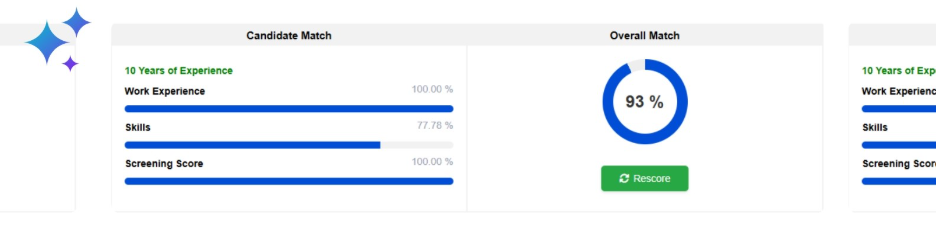
Dynamics ATS, for example, supports AI-assisted candidate scoring and screening workflows that give recruiters additional information for their evaluations.
The distinction matters:
AI provides decision support. Recruiters make the decision.
Human judgment remains essential when assessing nuance, motivation, communication, culture, career objectives, and other factors that cannot be reduced to a score.
Automation Handles What Happens Between Decisions
Not every recruiting inefficiency requires AI.
Many simply require automation.
A candidate moves to a new stage.
A hiring manager needs to provide feedback.
An interview needs to be scheduled.
A recruiter needs a reminder.
A candidate needs an update.
These actions follow predictable rules, which makes them good candidates for workflow automation.
Instead of recruiters remembering every administrative next step, the recruiting system can help keep the process moving.
Communication Can Be Automated Without Becoming Impersonal
Automated communication sometimes creates concerns about candidate experience.
But the alternative is often not personalized communication.
It is delayed communication.
Automation can help recruiters send timely confirmations, reminders, interview information, and status updates while preserving personal conversations for moments where they matter most.
The objective is not to automate every candidate interaction.
It is to ensure routine communication happens consistently so recruiters have more time for meaningful interaction.
Reporting Should Not Require Hours of Preparation
Recruiting teams generate data continuously.
Yet many still spend time manually compiling weekly or monthly reports.
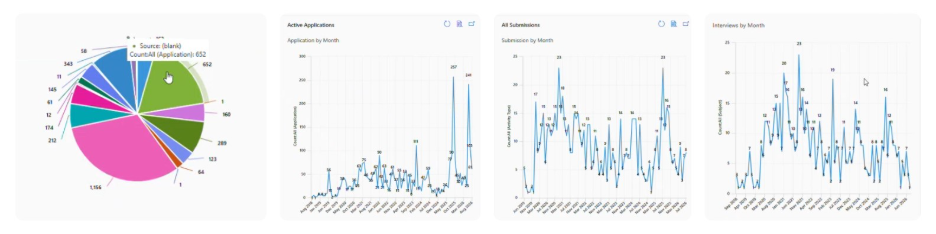
Connected dashboards can transform reporting from a periodic administrative task into an always-available operational view.
Recruiters and leaders can monitor pipeline activity, candidate progress, recruiter performance, sources, placements, and other metrics without rebuilding the same reports repeatedly.
The Recruiter Role Is Becoming More Strategic
LinkedIn’s research found another important shift: employers were 54 times more likely to list “relationship development” as a required recruiter skill in 2024 than in 2023.
That points to an interesting consequence of AI.
As technology becomes better at administrative and repetitive work, the skills that are difficult to automate become more valuable.
Relationship building. Consulting. Communication. Judgment. Negotiation. Understanding client and hiring manager needs.
AI does not necessarily make recruiters less important.
It can change what organizations need recruiters to be good at.
AI and Automation Inside Dynamics ATS
Dynamics ATS brings AI and automation into a connected recruiting environment built on Microsoft Dynamics 365 and Power Platform.
Recruiters can use AI across activities such as candidate matching, screening, summaries, job descriptions, interview preparation, and other recruiting workflows.
Power Automate can support workflow automation across recruiting and other business processes, while Power BI provides visibility into operational performance.
Instead of introducing isolated AI tools for individual tasks, organizations can incorporate AI and automation into the broader recruiting workflow.
Automate the Process, Not the Relationship
The most useful question about recruiting AI is not how much of recruiting can be automated.
It is which work recruiters should no longer need to perform manually.
Let technology organize information, automation manage predictable processes, AI accelerate analysis. and let recruiters spend more of their time on the decisions and relationships where human expertise matters.
See how Dynamics ATS combines AI, automation, CRM, ATS, and recruiting operations within the Microsoft ecosystem. Schedule a demo to explore the platform.