

Executive Search CRM: Connecting Business Development and Search Execution
Nearly 40% of the skills required on the job are expected to change by 2030, according to the World Economic Forum’s Future of Jobs Report 2025. At the same time, 63% of employers identify skills gaps as a major barrier to business transformation. For executive search firms, this rapidly changing talent landscape makes knowledge of clients, markets, candidates, and relationships increasingly valuable. An executive search CRM helps firms connect that knowledge across business development and search execution.
Without that connection, valuable context can be lost between the moment a business opportunity is identified and the moment a placement is completed.
Executive search has a different sales cycle
Business development in executive search does not follow a traditional transactional sales process.
A relationship may develop over months or years before becoming a mandate. A former candidate may later become a client. A completed search can lead to another engagement in a different department, business unit, or market.
That makes relationship history extremely valuable.
Executive search firms need to understand more than which opportunities are currently open. They also need visibility into:
- Who introduced the relationship
- Which consultants know the client or candidate
- Which searches have already been completed
- Who the key stakeholders are
- What conversations have taken place
- Which candidates have previously interacted with the firm
- How relationships have developed over time
This context helps consultants identify opportunities, prepare for conversations, and strengthen long-term relationships.
What happens when CRM and search execution are separate?
In many firms, partners manage relationships and business development, researchers and recruiters execute searches, operations teams track engagements, and leadership monitors revenue and pipeline performance.
Although these activities are closely connected, the systems supporting them often are not.
Separating CRM from recruiting creates an artificial boundary between winning business and delivering it. Information must then be transferred manually between systems, spreadsheets, emails, and individual team members.
This can lead to:
- Incomplete handoffs between business development and recruiting
- Duplicate or poorly coordinated outreach
- Fragmented client and candidate communication histories
- Limited visibility into previous searches and engagements
- Relationship knowledge remaining in individual inboxes
- Difficulty connecting business development activity with placements and revenue
A connected executive search CRM reduces these gaps by keeping relationship, opportunity, search, and candidate information in the same environment.
Connecting the opportunity-to-placement lifecycle
A more connected operating model treats business development and search execution as stages of the same relationship lifecycle:
Relationship → Opportunity → Search → Candidate Pipeline → Placement → Future Opportunity
Each stage generates information that can support the next.
The history of a client relationship provides context when a new opportunity emerges. Information collected during business development helps the recruiting team understand the client, position, and stakeholders. A completed search then contributes new knowledge that can support future conversations and engagements.
Instead of moving information between disconnected systems, the firm can maintain a continuous record of the relationship from the first interaction to the placement—and beyond.
Turning relationship intelligence into a firm-wide asset
Executive search firms accumulate significant relationship intelligence over time.
Partners understand clients and markets. Recruiters develop knowledge of candidates and talent pools. Researchers identify connections between companies, roles, and industries. Operations teams maintain information about engagements and outcomes.
If this knowledge remains primarily in personal notes, spreadsheets, or individual inboxes, it can be difficult for the wider organization to access. It may also disappear when consultants change roles or leave the firm.
A centralized CRM and ATS environment allows interactions to contribute to a shared institutional knowledge base.
Over time, the firm gains deeper visibility into:
- Client and candidate relationships
- Previous mandates and placements
- Stakeholder activity
- Communication history
- Candidate networks
- Market expertise
- Search outcomes
This does not replace the individual knowledge and judgment of consultants. It makes that knowledge more accessible and useful across the firm.
Improving pipeline visibility and forecasting
Connecting CRM and recruiting data also gives leadership a clearer view of the relationship between commercial activity and search delivery.
With information in one environment, firms can better understand:
- Which opportunities are most likely to convert
- Which clients generate repeat business
- What mandates may be coming next
- How active searches relate to expected revenue
- Where engagements are progressing or slowing down
- Which relationships may require follow-up
Instead of building forecasts from disconnected spreadsheets and individual partner updates, leadership can work from a more consistent operational picture.
This visibility can also help firms identify patterns across clients, industries, consultants, and search types.
Where AI fits into executive search
AI can support candidate discovery, profile summarization, communication drafting, research, matching, and repetitive administrative work.
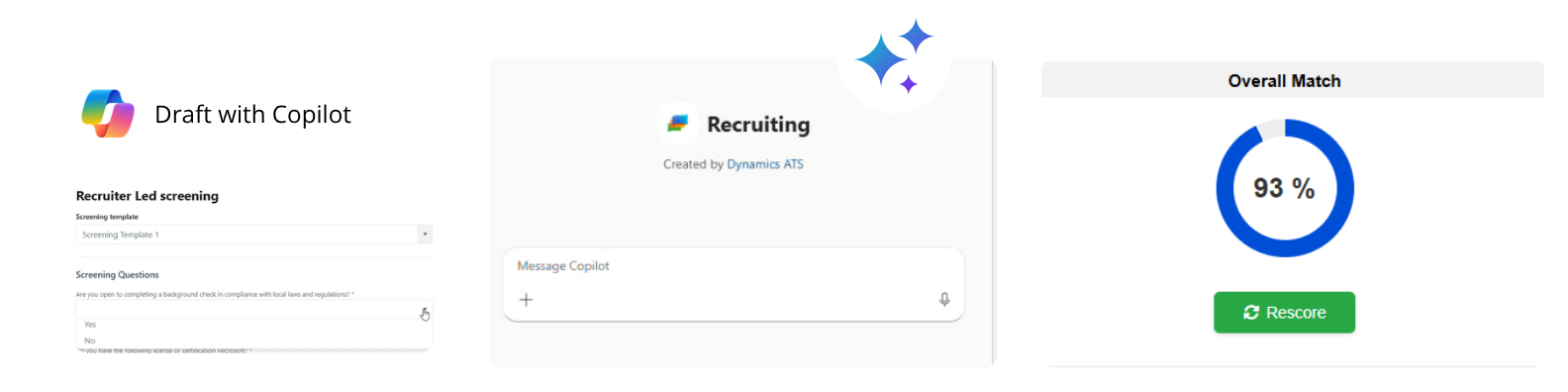
However, the value of AI depends heavily on the information available to it.
When client, candidate, relationship, opportunity, and search information is fragmented, AI has less context to work with. When that information is connected, AI can help consultants navigate a much richer knowledge environment.
For example, it can assist teams in identifying relevant candidates, reviewing previous interactions, summarizing profiles, drafting personalized communications, and finding information across a wider relationship network.
The goal is not to replace the relationship-driven nature of executive search. It is to reduce the administrative effort required to understand and act on those relationships.
One executive search CRM for business development and recruiting
Dynamics ATS combines CRM and ATS capabilities within the Microsoft Dynamics 365 and Power Platform ecosystem.
Executive search firms can manage business development opportunities, client relationships, candidates, searches, placements, communications, reporting, and workflows within a connected environment.
Because the platform is built within the Microsoft ecosystem, teams can connect recruiting and relationship management with the tools and data they already use across their organization.
This gives partners, recruiters, researchers, operations teams, and leadership shared visibility while allowing each group to work with the information most relevant to its role.
From individual relationships to institutional intelligence
Relationships will always be at the center of executive search. Technology should not replace them.
It should help firms retain, connect, and act on the knowledge those relationships create.
By connecting business development with search execution, an executive search CRM can help firms turn individual relationship activity into institutional intelligence, improve visibility across the opportunity-to-placement lifecycle, and build a more scalable operating model.
See how Dynamics ATS connects CRM, executive search, relationship management, AI, and recruiting operations in one Microsoft-based platform. Request a live demo.