
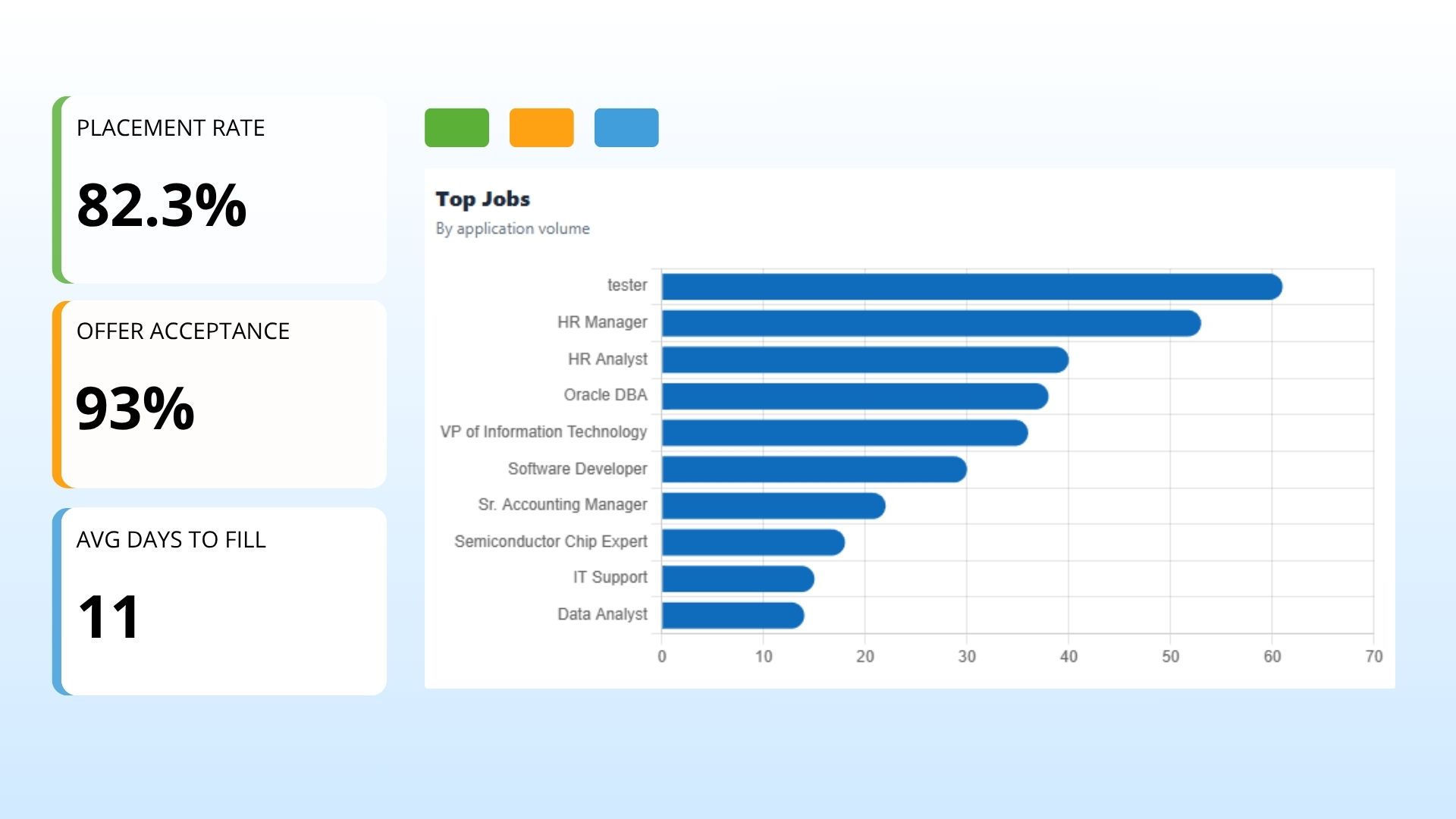
Nearly 7 in 10 organizations (69%) reported difficulty recruiting for full-time positions in 2025, according to SHRM 2025 Talent Trends: Recruiting
When recruiting becomes difficult, the natural response is often to increase activity: post more jobs, source more candidates, add recruiting tools, or expand outreach.
But more activity does not necessarily solve the underlying problem.
Sometimes the biggest opportunities are already inside the recruiting process itself: a slow screening stage, inconsistent hiring manager feedback, repetitive administrative work, poor candidate communication, or limited visibility into pipeline performance.
A recruiting process audit can help teams identify those gaps before adding more complexity.
1. Start With the Recruiting Funnel
The first step is understanding how candidates move through your process.
Look at the complete journey:
Application → Screening → Interview → Evaluation → Offer → Hire
Then measure what happens between each stage.
Useful questions include:
- How long do candidates remain in each stage?
- Where do the largest drop-offs occur?
- Which roles consistently take longer to fill?
- How quickly does the team respond to qualified candidates?
- How long does hiring manager feedback take?
- What percentage of interviews convert into offers?
Looking only at overall time-to-fill can hide the actual problem.
Breaking the process into stages makes bottlenecks easier to identify.
2. Find the Manual Work Recruiters Repeat Every Day
Recruiters perform dozens of small administrative tasks that can appear insignificant individually.
Updating candidate records. Sending reminders. Moving candidates between stages. Preparing interview information. Following up with hiring managers. Creating reports.
The important question is not whether these tasks take five minutes.
It is how many times recruiters repeat them every week.
A useful process audit should identify tasks that are:
- Repetitive
- Rules-based
- High-volume
- Administrative
- Easy to standardize
Those are usually the strongest candidates for automation.
The objective is not to remove recruiters from the process. It is to protect their time for work that requires judgment, communication, and relationship building.
3. Review How Candidate Information Moves
Candidate information should become more useful as someone progresses through the recruiting process.
But that does not always happen.
Resume information may exist in one place, screening responses somewhere else, interview feedback in email, and hiring manager comments in Teams or other communication tools.
When information is fragmented, recruiters spend time reconstructing candidate context instead of using it.
Ask:
Can everyone involved in a hiring decision easily access the information they need?
If the answer depends on searching through emails, spreadsheets, documents, or multiple applications, there is an opportunity to improve the workflow.
4. Evaluate Hiring Manager Collaboration
Recruiting performance does not depend on recruiters alone.
Hiring manager response times, interview feedback, approvals, and decisions can significantly affect how quickly candidates move.
An audit should therefore examine:
- How candidates are presented to hiring managers
- Where feedback is captured
- How long feedback typically takes
- How pending actions are communicated
- Whether responsibilities are clearly assigned
- Whether recruiters need to repeatedly chase updates
Shared visibility and automated reminders can remove many of these delays without creating additional administrative work.
5. Examine Candidate Communication
Candidates experience your recruiting process differently from your internal team.
They do not see workflows, integrations, or internal approvals.
They experience response times.
A candidate may interpret several days without communication as a lack of interest, even if the recruiting team is simply waiting for internal feedback.
Review where candidates commonly experience silence:
- After applying
- After screening
- Between interviews
- While waiting for feedback
- Before an offer or rejection
Automation can support timely communication at predictable stages while recruiters retain control of conversations that require a personal approach.
6. Look at What Your Reporting Actually Tells You
Recruiting teams often collect large amounts of data without necessarily having the visibility they need.
An audit should distinguish between activity metrics and performance metrics.
Knowing how many candidates were submitted is useful.
Knowing what percentage of those candidates reached an interview is more actionable.
Knowing how many interviews occurred is useful.
Knowing which stages consistently create delays is more actionable.
Useful metrics may include:
- Time-to-fill
- Time-in-stage
- Application-to-screen conversion
- Submission-to-interview conversion
- Interview-to-offer conversion
- Source effectiveness
- Candidate response rates
- Recruiter activity and productivity
Reporting should help teams identify where action is needed, not simply document what already happened.
7. Identify What Should Be Automated, Improved, or Removed
Once the gaps are visible, every issue does not require a new technology solution.
Some processes need automation.
Others need clearer ownership.
Some workflows need to be simplified.
And some steps may no longer be necessary at all.
The objective of a recruiting process audit is not to make every stage more sophisticated.
It is to remove unnecessary friction.
Building Continuous Improvement Into Recruiting
Recruiting processes should not remain static.
Hiring volume changes. Candidate expectations evolve. AI capabilities improve. Teams grow. Business requirements shift.
Dynamics ATS provides recruiting teams with a connected environment for managing candidates, workflows, communication, automation, AI, collaboration, and reporting on the Microsoft platform.
With Power BI, Power Automate, Microsoft 365, and Dynamics ATS working within the same ecosystem, organizations can gain greater visibility into recruiting performance and continuously adapt their workflows.
Start With the Process, Not Another Tool
When recruiting performance needs improvement, adding another sourcing channel or technology product may seem like the fastest solution.
Sometimes it is.
But first, understand what is already happening inside the process.
Find where candidates wait.
Find where recruiters repeat work.
Find where information gets lost.
Find where conversion drops.
Those are the areas where operational improvements can have the greatest impact.
Want to see how Dynamics ATS can help connect and automate your recruiting workflows? Schedule a demo to explore the platform.